REVIEW · ISTANBUL
Skip-the-Line Hagia Sophia Digital Tickets w/Audio Guide
Book on GetYourGuide →Operated by City-Pass.Tr · Bookable on GetYourGuide
The Hagia Sophia hits fast. This skip-the-line digital ticket plus an English audio guide helps you move through one of Istanbul’s most famous interiors at your own rhythm.
I like two things right away: you get a self-paced visit inside a UNESCO World Heritage Site, and the audio guide helps you connect what you’re seeing to the Byzantine and Ottoman eras.
One thing to plan for: the ticket doesn’t guarantee you’ll bypass security, and in busy periods entry can still slow you down.
In This Review
- Key highlights worth your attention
- What this skip-the-line ticket really covers at Ayasofya
- Entering Hagia Sophia: the tourist entrance near Topkapi Palace
- The English audio guide: how to use it without losing time
- Inside Hagia Sophia: what to notice in the dome, mosaics, and calligraphy
- Byzantine and Ottoman layers: making sense of the story as you walk
- Timing and lines: why one hour can feel short
- Renovation realities and what that means for photos
- Ticket codes, QR access, and how to avoid losing your hour
- Who this is best for—and who should reconsider
- Value check: is $41 for a 1-hour self-guided visit worth it?
- Provider note: City-Pass.Tr and what to expect if something goes wrong
- Quick tips to make your one-hour visit work
- Should you book this skip-the-line Hagia Sophia digital ticket?
- FAQ
- Do I need to download an app for the Hagia Sophia audio guide?
- How long does the Hagia Sophia visit take?
- Where do I enter Hagia Sophia?
- Does this ticket skip security lines?
- Is the audio guide in English?
- Is flash photography allowed inside?
- What should I bring?
- Is this experience suitable for wheelchair users?
- Is hotel pickup or drop-off included?
- Can I cancel for a full refund?
Key highlights worth your attention
- Skip-the-line entry, not skip-the-security: you may still wait at checkpoints, especially at peak hours.
- Upper-floor access via a tourist entrance: foreigners can use the entrance near Topkapi Palace with a gentle ramp to upper galleries.
- Smartphone English audio guide: you listen as you go, with context for the dome, mosaics, and calligraphy.
- A one-hour window that rewards focus: you’ll need to prioritize your must-sees.
- Expect occasional access changes: some zones mentioned by the audio may not be open during renovations.
What this skip-the-line ticket really covers at Ayasofya

This is a self-guided Hagia Sophia visit with two core parts: a skip-the-line entry ticket and an audio guide delivered to your smartphone. That combo sounds simple, and it is. The key is understanding what skip-the-line does—and what it doesn’t.
Your ticket helps you avoid the ticketing queue, but the experience still includes security processing at the entrance. During peak seasons, you should assume there will be lines at security checkpoints. In other words: this doesn’t turn your visit into a straight-shot sprint, but it can shave off the slowest part.
The practical advantage is control. You decide when to pause for photos, where to stand to get the best view of the dome, and how long to linger over mosaics and historic calligraphy. If you’re the type who likes to learn as you look, the audio guide is a good match for your pace.
You can also read our reviews of more tours and experiences in Istanbul



Entering Hagia Sophia: the tourist entrance near Topkapi Palace
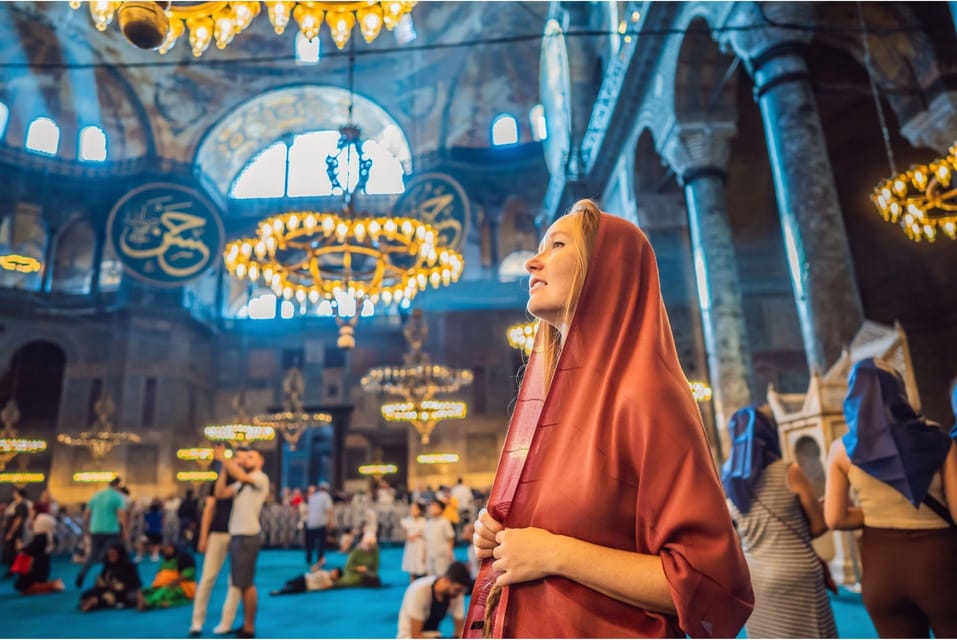
You meet at Hagia Sophia (Ayasofya) and enter on your own. That sounds obvious, but it matters here because the arrival flow can be confusing if you show up without a plan.
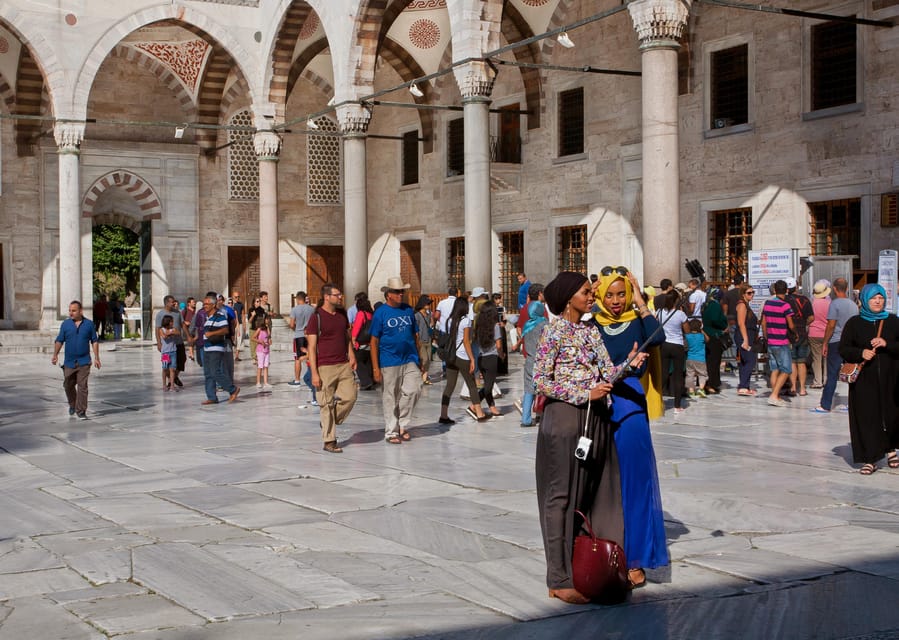
For foreign visitors, the data you’ll want to remember is that you enter through a newly opened tourist entrance near Topkapi Palace. From there, you get direct access to the upper floor galleries via a gentle ramp. That route can be easier to navigate than random entrances, especially when the main area is busy.
The main “gotcha” is timing. Even with skip-the-line entry, you can face a longer wait for security when it’s crowded. A calm approach helps: plan for delays, keep your phone charged, and wear shoes you can walk in without thinking about it.
The English audio guide: how to use it without losing time
The audio guide is available in English and it’s designed for an at-your-own-pace visit. So instead of marching behind a group, you’ll get narration you can trigger as you move through the building.
What it covers (based on the tour info) is the story of Hagia Sophia through both the Byzantine and Ottoman empires. That matters because Hagia Sophia isn’t just “a beautiful building.” It’s a layered space—one that changes meaning depending on the era you focus on.
Here’s how to get more out of a 1-hour visit. Don’t try to listen to everything from start to finish like it’s a podcast playlist. Use it as a guide to where your attention should go next. If you hear a segment that points you toward the dome or a mosaic area, go look first, then listen again. You’ll feel like you’re building a mental map as you walk.
Also note the restriction: flash photography isn’t allowed inside. That’s not about the audio guide itself, but it affects how long you’ll want to stop. If you’re photographing, plan for ambient light only, and give yourself a little extra time where the view is best.
Inside Hagia Sophia: what to notice in the dome, mosaics, and calligraphy
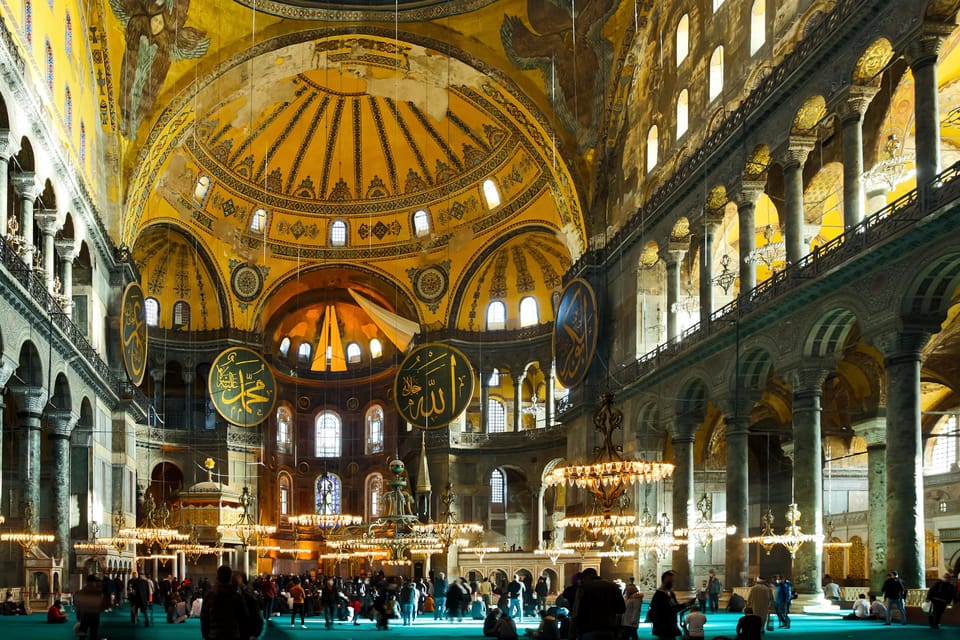
Hagia Sophia is famous for three things in visitor-friendly terms: the dome, the mosaics, and the historic calligraphy. The tour info is straightforward on this, and you’ll see why once you’re inside.
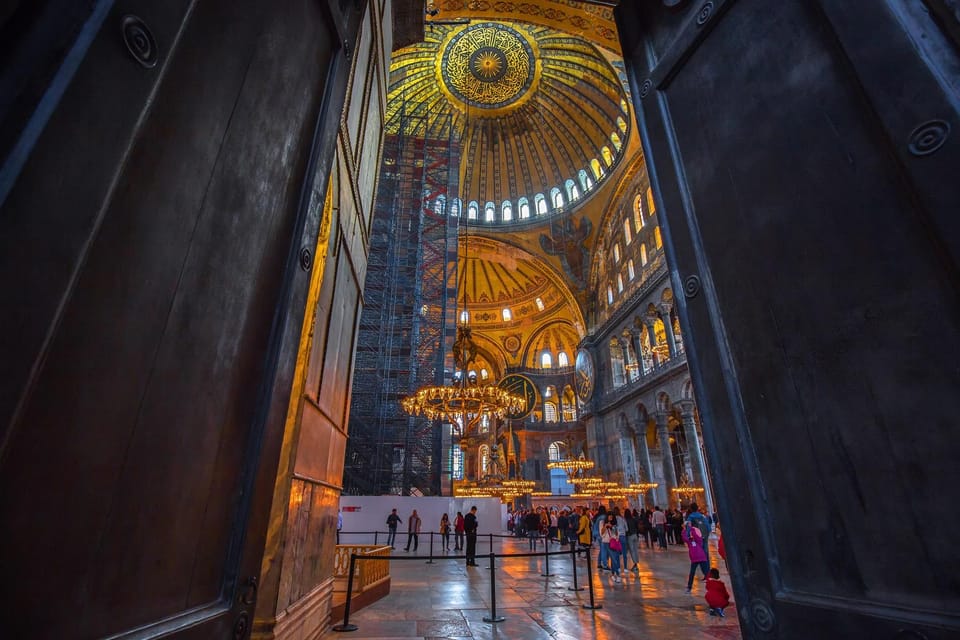
The dome is the first big “wow” moment. Even if you’ve seen it in photos, it’s the scale and geometry that tend to land. When you’re near the dome area, take a few seconds to look up before you start scanning for details. The audio guide can help you frame what you’re seeing in architectural terms, not just aesthetic ones.
The mosaics are your second anchor. They’re not random decoration; they connect directly to the Byzantine visual tradition. Give yourself time to stand still. In a crowded interior, it’s easy to keep moving. Slow down for 30–60 seconds at a time, so you’re actually reading the surfaces instead of just passing by them.
Historic calligraphy is the third big thing. It’s where the Ottoman influence becomes visible in a way that’s easy for modern visitors to spot. If you’re listening to the audio while you look, you’ll likely start noticing how different styles “take over” space depending on the era.
One more practical point: the experience is built around a smartphone audio experience. That means you’ll spend part of your visit focused on the screen and part focused on the building. To avoid frustration, keep one hand free for holding your phone and use a comfortable stance. Don’t choose a path that forces you to constantly squeeze past people.
Byzantine and Ottoman layers: making sense of the story as you walk
The audio guide is your “through-line” here. It’s meant to help you understand the Byzantine and Ottoman chapters connected to Hagia Sophia.
I like this approach because it turns the visit from a list of pretty things into a sequence you can follow. When you’re in a historic building with many eras, it’s common to feel like you’re just looking at effects—without knowing what caused the changes.
With this audio guide, you get narration that ties what you’re seeing to what happened in the building’s past. You’ll still have your own interpretations, but the guide helps you ask better questions: Who commissioned what? When did the style shift? What kind of craft were artisans applying here?
If you’re visiting with kids or friends who don’t want a long lecture, the audio guide can still work. It gives structure without forcing anyone into group timing. And if you’re more of a solo learner, it gives context when the building would otherwise feel overwhelming.
You can also read our reviews of more guided tours in Istanbul





Timing and lines: why one hour can feel short
The duration listed is 1 hour. That’s a real limit, even if the building obviously isn’t timed like a ride at a theme park. In practice, your hour starts feeling tight the moment you’re dealing with security or settling into the right listening flow.
The skip-the-line part helps, but multiple practical bottlenecks can still eat time:
- security checkpoints during peak hours
- finding your entry route
- getting your audio guide running smoothly on your phone
So you’ll want a simple strategy. Pick your “must-see triad”: dome, mosaics, calligraphy. Then allow a little flexibility for one extra stop if time remains. This way, you’re not trying to absorb the entire building in one sitting—which is impossible for most people, even on a slow day.
One important consideration from the experience feedback: even with an organized entry, some people still report waiting at security. In the busiest periods, entry may take longer than usual. Don’t plan a tight schedule afterward unless you’re okay with a buffer.
Renovation realities and what that means for photos

Hagia Sophia is an active site, and at times you may see renovation elements around the building. In the feedback you were given, one issue stood out: scaffolding can make it harder to fully appreciate the outside beauty when you arrive and look around briefly before or after entry.
Inside, you can still focus on what you came for: the dome, mosaics, and calligraphy. But the “outside impression” might not match what you imagined from classic postcards.
Also remember the photo rule: no flash photography. If you’re trying to get bright shots, you’ll need to rely on available light and your phone’s camera settings. Give yourself extra seconds in the areas that are darker, since taking photos in low light can be slower.
Ticket codes, QR access, and how to avoid losing your hour
This experience is digital ticket-based. That means you’re depending on the code or QR process to get you in smoothly.
The experience feedback includes a real-world warning: sometimes the ticket code you first receive may not be the final “enter” code, and there can be confusion about which code unlocks the entry and audio guide. One account described a problem with the QR code that required extra time at the start.
Here’s what I’d do to protect your schedule:
- Have your confirmation details ready on your phone before you reach the entrance.
- If something looks off, handle it right away rather than delaying until you’re already inside time pressure.
Support can be responsive, but support calls and troubleshooting take time. If your goal is to finish within that 1-hour window, smooth tech access matters.
Who this is best for—and who should reconsider
This is a strong match if you want freedom over a structured tour. You’ll like it if:
- you enjoy learning at your own pace
- you prefer a smartphone guide rather than a live group explanation
- you want to focus on specific highlights like mosaics and calligraphy without rushing through everything
It’s not a great fit if you need step-free or wheelchair access. The info clearly says it’s not suitable for people with mobility impairments and wheelchair users. The site itself is complex, and this product doesn’t claim accessibility accommodations.
Also, if you’re the type who gets flustered by digital QR processes, consider arriving with extra time. The main risk isn’t the site; it’s the entry tech working exactly as expected.
Value check: is $41 for a 1-hour self-guided visit worth it?
At $41 per person, you’re paying for two things: skip-the-line entry and the convenience of a bundled audio guide. Whether that feels like a bargain depends on what you hate most during sightseeing.
If you dislike standing in ticket lines, paying this price can be worth it. Skip-the-line access can save the most frustrating kind of delay, especially in a place like Hagia Sophia where crowds are normal.
If you enjoy taking your time and you’re comfortable reading signage or using another free guide once inside, you might question the value of paying for an audio guide. The audio guide is English and clearly focused on Byzantine and Ottoman context, but you’re still on your own schedule.
The best way to think about value: this ticket is for visitors who want less waiting and more meaning per minute. If you show up prepared and use the audio guide strategically, that aligns with what you paid for.
Provider note: City-Pass.Tr and what to expect if something goes wrong
The experience provider listed is City-Pass.Tr. In general, the main lesson from the feedback you were given is that tech issues can happen, and when they do, the real test is whether you can solve them quickly.
If your QR or code doesn’t behave at the entrance, expect a troubleshooting moment that may cut into your 1-hour time. The good news is that at least some accounts describe support as reactive. The better news is that you can reduce the chance of trouble by keeping your confirmation details easily accessible and handling any code issue fast.
Quick tips to make your one-hour visit work
You only have 1 hour, so these small choices matter:
- Wear comfortable shoes. The building involves a moderate amount of walking.
- Bring water, but note food and drinks aren’t allowed inside.
- Plan around your top three highlights: dome, mosaics, calligraphy.
- Keep flash off and shoot with ambient light.
- If crowds spike, don’t argue with the pace—watch the dome and listen, then move on.
If you do those things, you’ll leave with the feeling that you used your time well, even if security lines stretched a bit.
Should you book this skip-the-line Hagia Sophia digital ticket?
Book it if you want a self-guided visit with skip-the-line entry and an English audio guide that connects what you see to the Byzantine and Ottoman story. At $41, it’s a reasonable “pay for convenience” choice—especially if you’re visiting during busy hours and you hate waiting.
Skip it or book with extra caution if you’re relying on perfect QR behavior and you can’t afford a troubleshooting delay. The experience data you received includes examples of QR code confusion and access hiccups that ate time. If your schedule is razor-thin, build a buffer.
In short: this is a good fit for independent explorers who want highlights plus context, and who can handle the reality that security lines still exist.
FAQ
Do I need to download an app for the Hagia Sophia audio guide?
The audio guide is provided on your smartphone, and it’s available in English. The info doesn’t mention a specific app, so you’ll want to follow the instructions that come with your digital ticket.
How long does the Hagia Sophia visit take?
The duration is listed as 1 hour.
Where do I enter Hagia Sophia?
Go to Hagia Sophia (Ayasofya) and enter on your own. Foreigners can enter through the newly opened tourist entrance near Topkapi Palace.
Does this ticket skip security lines?
Your ticket is described as a skip-the-line entry ticket, but it does not provide priority access for security. Expect lines at security checkpoints during peak seasons.
Is the audio guide in English?
Yes, the audio guide is available in English.
Is flash photography allowed inside?
No. Flash photography is not allowed inside Hagia Sophia.
What should I bring?
Bring comfortable shoes, a camera, and water.
Is this experience suitable for wheelchair users?
No. It’s not suitable for people with mobility impairments or wheelchair users.
Is hotel pickup or drop-off included?
No. Hotel pickup and drop-off aren’t included.
Can I cancel for a full refund?
Yes. Free cancellation is available up to 24 hours in advance for a full refund.