REVIEW · ISTANBUL
Istanbul:Basilica Cistern Skip-the-Line Ticket & Audio Guide
Book on GetYourGuide →Operated by Istanbul Tourist Pass® · Bookable on GetYourGuide
One hundred thousand tons of water await underground. The Basilica Cistern (Yerebatan Cistern) is a Byzantine-era reservoir under Istanbul, and it’s an unusually satisfying stop because the space is made for wandering at your own pace. I love that you get skip-the-ticket-line entry so you can start the experience faster, and I love having an English audio guide to explain what you’re looking at, especially the 336 columns and the famous Medusa heads. One thing to plan around: you still can’t skip security lines, and you may still see a line at the entrance.
This is also a good “learn while you walk” kind of visit. The audio guide doesn’t just recite dates; it helps you read the room—how the columns are arranged, why the Medusa heads were placed here, and what makes this cistern feel so visual even though you’re standing in the dark.
In This Review
- Key things to know before you go
- Basilica Cistern in plain terms: what you’re actually walking into
- Your self-paced visit: how the e-tickets and audio guide fit together
- Entering the cistern: the 52-step descent that changes your pace
- The columns: why 336 of them feels more dramatic than it sounds
- Medusa heads: myth, mystery, and a perfect photo moment
- Using the English audio guide well: how to turn a self-guided visit into a smart one
- Views over the Golden Horn and Bosphorus: why the surrounding area matters
- Hagia Irene as a companion sight: why it shows up with the cistern
- Price and value: does $54 per person make sense?
- Who this experience is best for (and who might want something else)
- FAQ
- FAQ
- Is the audio guide included?
- Does this ticket include skip-the-line entry?
- Can I skip security lines?
- Where are the Basilica Cistern and Hagia Sophia in relation?
- How long is the ticket valid?
- How will I receive my tickets and audio guide?
- What language is the audio guide in?
- What internet service is included?
- What’s special about the Medusa heads in the cistern?
- What’s the cancellation policy?
- Should you book this Basilica Cistern skip-the-line + audio guide?
Key things to know before you go
- Skip-the-line entry to Basilica Cistern helps you get moving sooner, even though security lines still apply
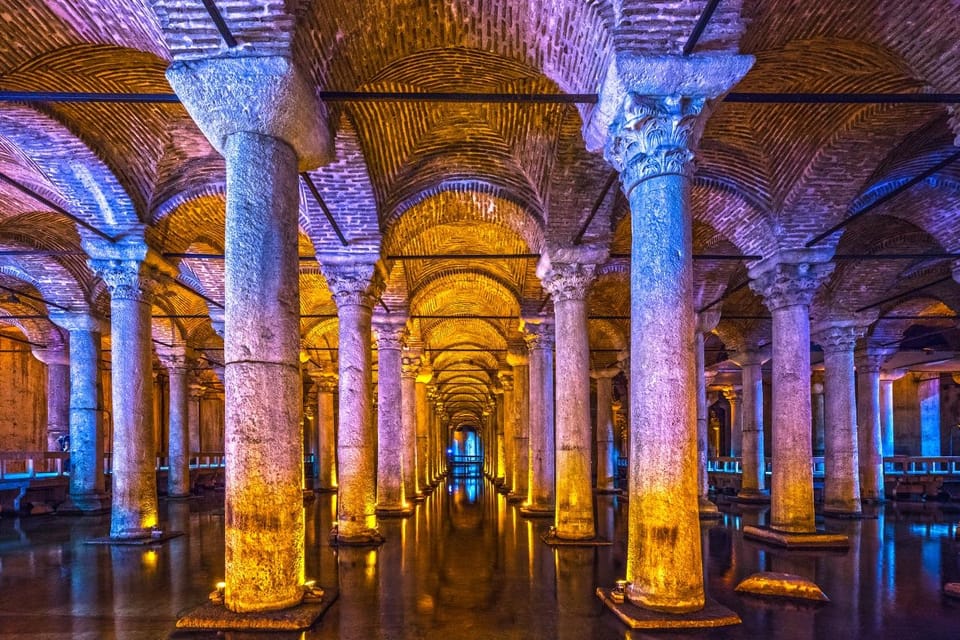
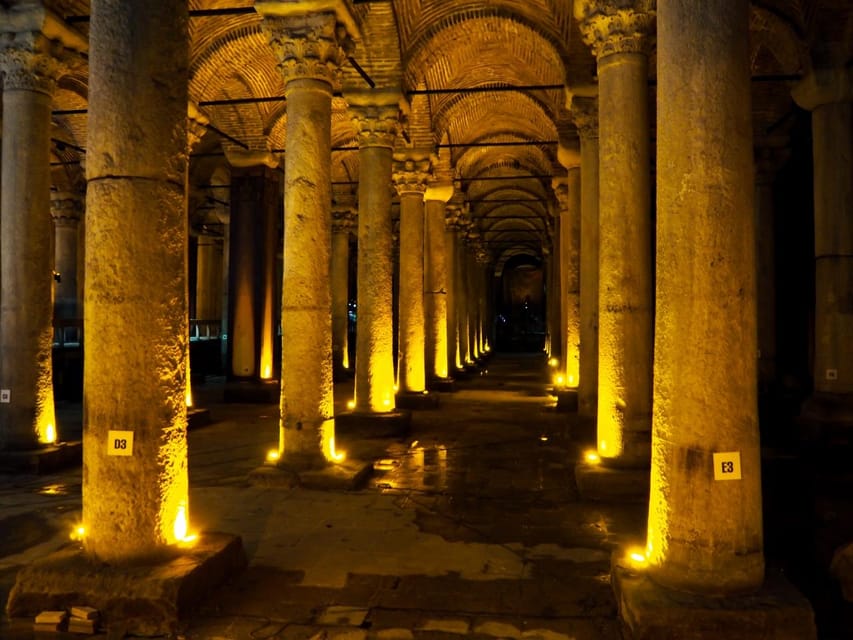
- 52 steps down into the cistern set the tone fast, with a wide underground chamber (140 m by 70 m)
- 336 columns in 12 rows means there’s always another angle to check
- Medusa heads on the northwest edge add a myth-filled twist to the engineering
- English audio guide is delivered as a link, separate from your entry QR codes
- Limited-time free eSIM internet is included with the ticket package
Basilica Cistern in plain terms: what you’re actually walking into

The Basilica Cistern is the big underground reservoir most people come to see in Sultanahmet. It sits southwest of Hagia Sophia, and it was built under Byzantine Emperor Justinian I, during the years 527 to 565. Today it’s known locally as Yerebatan Cistern because of the marble columns that appear like ghostly forest stems once you descend.
What makes it interesting is that this isn’t a museum-in-a-room. It’s a working-style interior you view from multiple directions. The columns create strong perspective lines, the ceiling feels far above (even when you’re under the ground), and the water-related design makes the air feel different than street level.
Also, if you’re the kind of traveler who likes seeing architecture that still looks impressive hundreds of years later, this one is built to impress. The cistern covers about 9,800 square meters, and estimates put its storage capacity around 100,000 tons of water. That number matters because it explains why the space feels so large when you’re standing in it.
You can also read our reviews of more tours and experiences in Istanbul


Your self-paced visit: how the e-tickets and audio guide fit together
This experience is set up for independent entry. You receive two things by email from the supplier Istanbul Tourist Pass:
- Your entry ticket QR codes
- A separate audio guide link (English)
That split is important. Keep an eye on both emails so you’re not scrambling once you’re near the entrance. Also note the key limitation: you cannot skip security lines. There can still be a line at the entrance, even if you have skip-the-ticket-line entry.
Timing-wise, the ticket is valid for 1 day, with available starting times listed when you check availability. Practically, this means you should plan your day so you can actually use that time window and not treat it as a flexible “any time later” pass.
The audio guide is included, so you’re not stuck guessing what you’re seeing. Instead, it gives you context while you walk through the chamber—exactly what you want underground, where signage may not be enough.
Entering the cistern: the 52-step descent that changes your pace

The cistern experience starts the moment you step down. There’s a staircase with 52 steps leading into the underground space. That’s not just a number; it’s your physical reset. The stairs compress your world into a narrower corridor, then—suddenly—you’re in a wide rectangular room that measures about 140 meters long and 70 meters wide.
As you enter, keep your eyes working horizontally. The room is built for looking from one side to the other. One glance toward the far end helps you register the scale, then you can pivot and follow the column rows back toward you.
If you like photos, this is a great venue. The columns and arches create natural “frames” for images. Just remember: you’re inside a subterranean environment, so lighting may be dim compared with outdoor sights. Go for angles over flash-lit shots.
The columns: why 336 of them feels more dramatic than it sounds
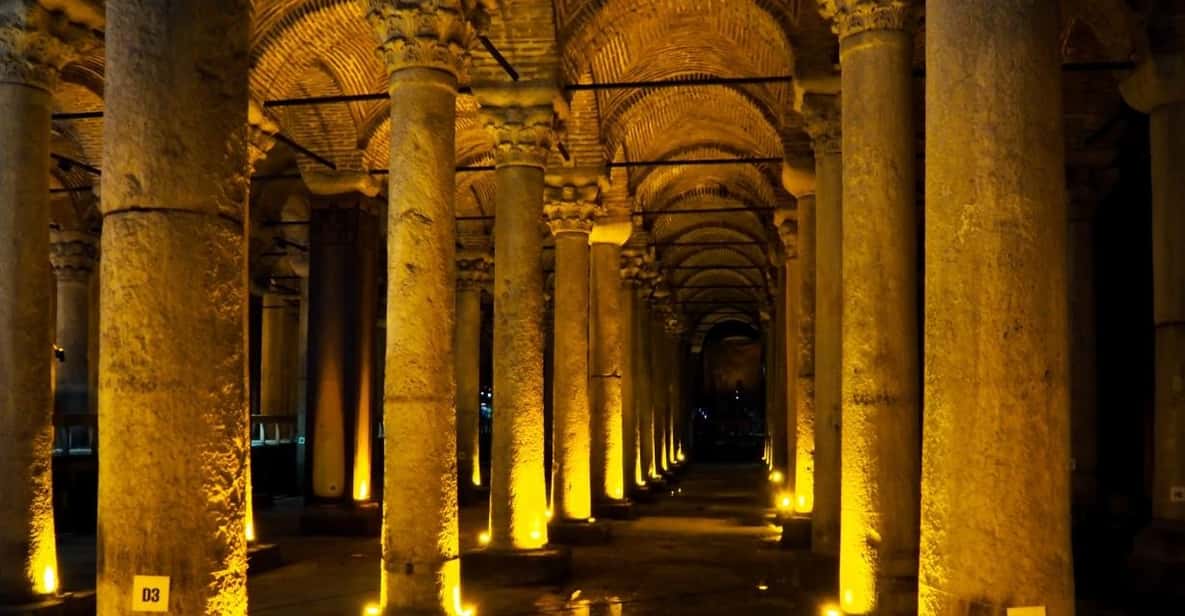
Inside, you’ll face 336 towering columns, each reaching around 9 meters tall. They’re arranged in 12 rows, with 28 columns per row. The columns are set roughly 4.80 meters apart, which is part of why the room feels so organized even though it seems vast.
A detail that makes the cistern more than a generic “old room” is that the columns weren’t all identical. The cistern uses columns taken from ancient structures, and different types of marble show up across the collection. Most columns appear to be single pieces, though a few are made in two parts.
You’ll also hear about architectural styles. About 98 columns are described as Corinthian style, and others reflect Dorian style. When an audio guide highlights that, it changes how you look at the columns: you stop seeing “many columns” and start seeing variations.
Then there’s the wall and floor engineering. Brick walls rise about 4.80 meters high, and the floor is covered with bricks and a thick layer of brick dust mortar to help make the cistern watertight. It’s practical design that you can’t fully appreciate from one spot, but it adds to the sense that this wasn’t just built to look good—it was built to last and hold water.
Medusa heads: myth, mystery, and a perfect photo moment
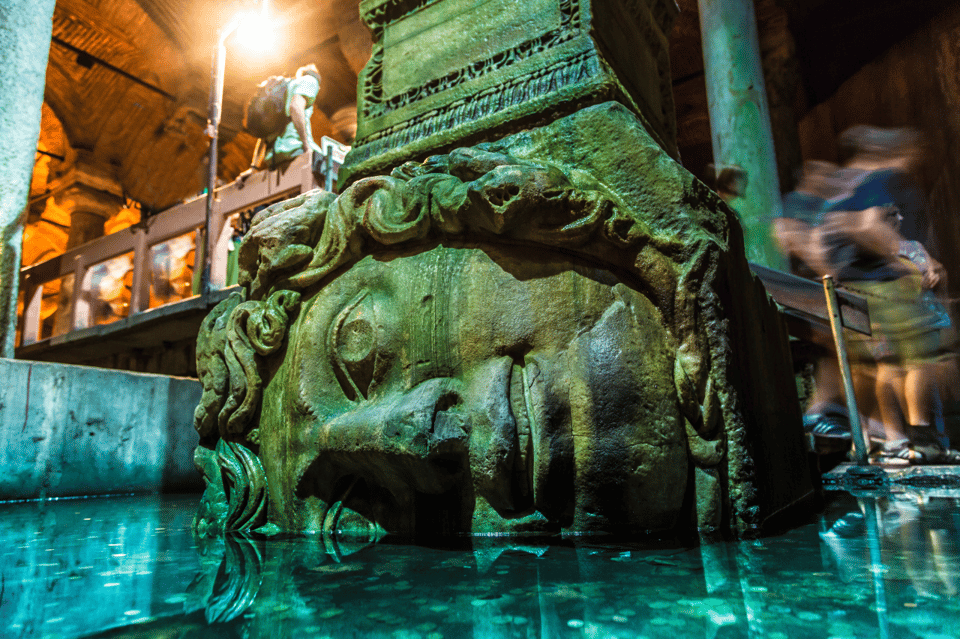
No matter how many columns you see, the Medusa heads are the moment people talk about. There are two Medusa heads used as supports under columns on the northwest edge of the cistern.
The origin story is part history, part mystery. The heads are said to date to the Roman period, but their exact origins aren’t known. Researchers speculate they may have been brought here to help support columns during the cistern’s construction.
Then the myth layer kicks in. In Greek mythology, Medusa is one of the Gorgons, a figure whose gaze can turn people into stone. Because of the myth’s power, depictions of Gorgons were sometimes believed to protect important places. Placing Medusa heads here is often explained as a protective idea tied to guarding special structures.
When you combine that myth with the engineering reality (they’re literally supporting columns), the cistern becomes more human and more playful. You’ll feel it most when you pause, look down, and realize you’re standing near a reused artifact that had a new job in this underground space.
You can also read our reviews of more guided tours in Istanbul





Using the English audio guide well: how to turn a self-guided visit into a smart one
An audio guide shines in places like this because you can’t absorb everything just by reading labels. Here, the guide helps you understand patterns:
- Why the cistern’s shape and size matter
- How the column rows are organized
- What the Corinthian vs. Dorian references mean
- Why the Medusa heads are placed where they are
The audio is in English, so you won’t be forced to translate. And because it’s self-paced, you can pause when a section grabs you. If you’re interested in architecture details, linger around the columns. If you want the stories, wait for the Medusa explanation and then look for the northwest edge.
A practical tip: save your phone battery. Underground lighting can make phones work harder, and you’ll want enough power to keep the audio guide running smoothly.
Views over the Golden Horn and Bosphorus: why the surrounding area matters
One advantage of building your day around the cistern is that the area around it can give you something different from the underground room. Highlights for this experience include views over the Golden Horn and the Bosphorus.
You’re not walking a long loop in a guided bus tour. Instead, you’ll likely experience these views while moving between nearby stops. That makes the visit feel more connected: you go from underwater-like quiet underground to open-city skyline light a short walk away.
If you’re planning your day, pair the cistern with time to look at the water views after. It turns one attraction into a more complete Istanbul moment.
Hagia Irene as a companion sight: why it shows up with the cistern
Another highlight connected to this experience is Hagia Irene, described here as the second biggest church of Istanbul. The cistern is often framed with Hagia Sophia area sights, and Hagia Irene fits that theme.
What matters for you is the contrast. The Basilica Cistern is about water storage and architecture built into the earth. Hagia Irene points you toward the religious and historical layers above ground. Even if you mainly treat Hagia Irene as a nearby companion rather than your main target, it helps your day feel less like a single-photo stop and more like a story you’re assembling in layers.
Price and value: does $54 per person make sense?
At $54 per person, you’re paying for a bundle of two real advantages:
- Skip-the-ticket-line entry to the Basilica Cistern
- An English audio guide included with your purchase
Skip-the-line access is the first money-saver. If you’ve ever waited behind slow-moving entries, you know time is part of value. Even if there’s still security screening, removing the ticketing line helps you start earlier.
The audio guide adds value because this cistern has details you’d otherwise miss. The difference between seeing “a lot of columns” and understanding the 12-row, 336-column arrangement, the architectural style notes, and what the Medusa heads are doing changes the visit from sightseeing to understanding.
One more small value boost: the package includes limited-time free internet via eSIM. It’s not the main reason to come, but it’s useful—especially if you’re relying on the audio guide link on your phone.
If you’re the type who likes self-guided flexibility and wants an explanation without joining a tour group, this price can feel fair. If you already know the cistern inside out and you don’t care about skip-the-line or audio, then it’s harder to justify.
Who this experience is best for (and who might want something else)
This works well for you if:
- You like architectural sights and want the details explained in plain English
- You prefer self-paced exploring rather than group marching
- You want a meaningful stop near Hagia Sophia without adding extra complexity
It may be less ideal if:
- You’re only interested in the fastest possible quick photo stop and don’t want any audio guidance
- You strongly dislike underground environments, since the experience requires descending stairs into a subterranean space
Also, the inclusion of Hagia Irene and water-view context makes it a good match for travelers who enjoy stitching sights into a coherent day.
FAQ
FAQ
Is the audio guide included?
Yes. The package includes a professional audio guide in English.
Does this ticket include skip-the-line entry?
This package includes skip-the-line entry to the Basilica Cistern. The skip-the-line benefit is not included if you only purchase the audio guide option.
Can I skip security lines?
No. It is not possible to skip security lines, and there could be a line at the entrance.
Where are the Basilica Cistern and Hagia Sophia in relation?
The Basilica Cistern is located southwest of Hagia Sophia.
How long is the ticket valid?
The ticket is valid for 1 day. You’ll need to check availability to see starting times.
How will I receive my tickets and audio guide?
You’ll receive both entry ticket QR codes and the audio guide link via separate email from the supplier Istanbul Tourist Pass.
What language is the audio guide in?
The audio guide is included in English.
What internet service is included?
Limited-time free internet is included via an eSIM.
What’s special about the Medusa heads in the cistern?
There are two Medusa heads serving as supports under columns on the northwest edge of the cistern.
What’s the cancellation policy?
You can cancel up to 24 hours in advance for a full refund.
Should you book this Basilica Cistern skip-the-line + audio guide?
If you want a smart, self-paced Istanbul stop with time saved at the entrance, I’d book it. The combination of skip-the-ticket-line entry plus an English audio guide is the heart of the value here, and the cistern itself is exactly the kind of place where context makes a big difference—especially around the 336 columns and the Medusa heads. Just be ready for security lines at the entrance and treat the visit as a planned, underground experience rather than a quick in-and-out errand.
If that matches your style, this is a strong pick for your day near Hagia Sophia.